Wedding Planning Guides
How Long Does It Take to Plan a Wedding?
Planning a wedding typically takes 12 to 18 months, but that range is almost useless without context. What actually determines your timeline is a small number of variables: the size of the wedding, the type of venue, the time of year, and whether you are planning locally or in another city. Understanding those variables tells you far more than a generic number does.
What Actually Determines Your Timeline
Four variables drive how long you need. Venue type and availability is the biggest one. Peak-season Saturday venues in major markets book out 12 to 18 months ahead. Guest count matters because larger weddings involve more vendor coordination and longer lead times. Wedding season matters because peak dates have fewer vendor slots and fill faster. Destination weddings need more time regardless of size because planning remotely removes the ability to do last-minute in-person visits. A Thursday evening wedding at a restaurant for 30 guests can be planned in three months. A Saturday peak-season wedding for 150 requires at least 12. The number follows from the specifics, not the other way around.
The 12 to 18 Month Timeline: What Happens When
The planning window breaks into five phases. The first phase, venue, date, and guest count, needs to be complete by month 12. The second phase, core vendor bookings, runs from month 9 to 12. The third phase, invitations, florals, and accommodation blocks, runs from month 6 to 9. The fourth phase, RSVPs, seating, and vendor confirmations, runs from month 3 to 6. The final phase, locking everything in and handing operational responsibility to someone other than you, runs through the last 3 months. Each phase depends on the previous one being complete. A delay in phase one does not extend the timeline. It compresses every phase after it.
The Planned Wedding includes a 53-task wedding planning checklist that organises every task by month based on your wedding date. Enter your date and the tasks reorganise automatically around your specific timeline. Start free — no credit card required.
Start your free trial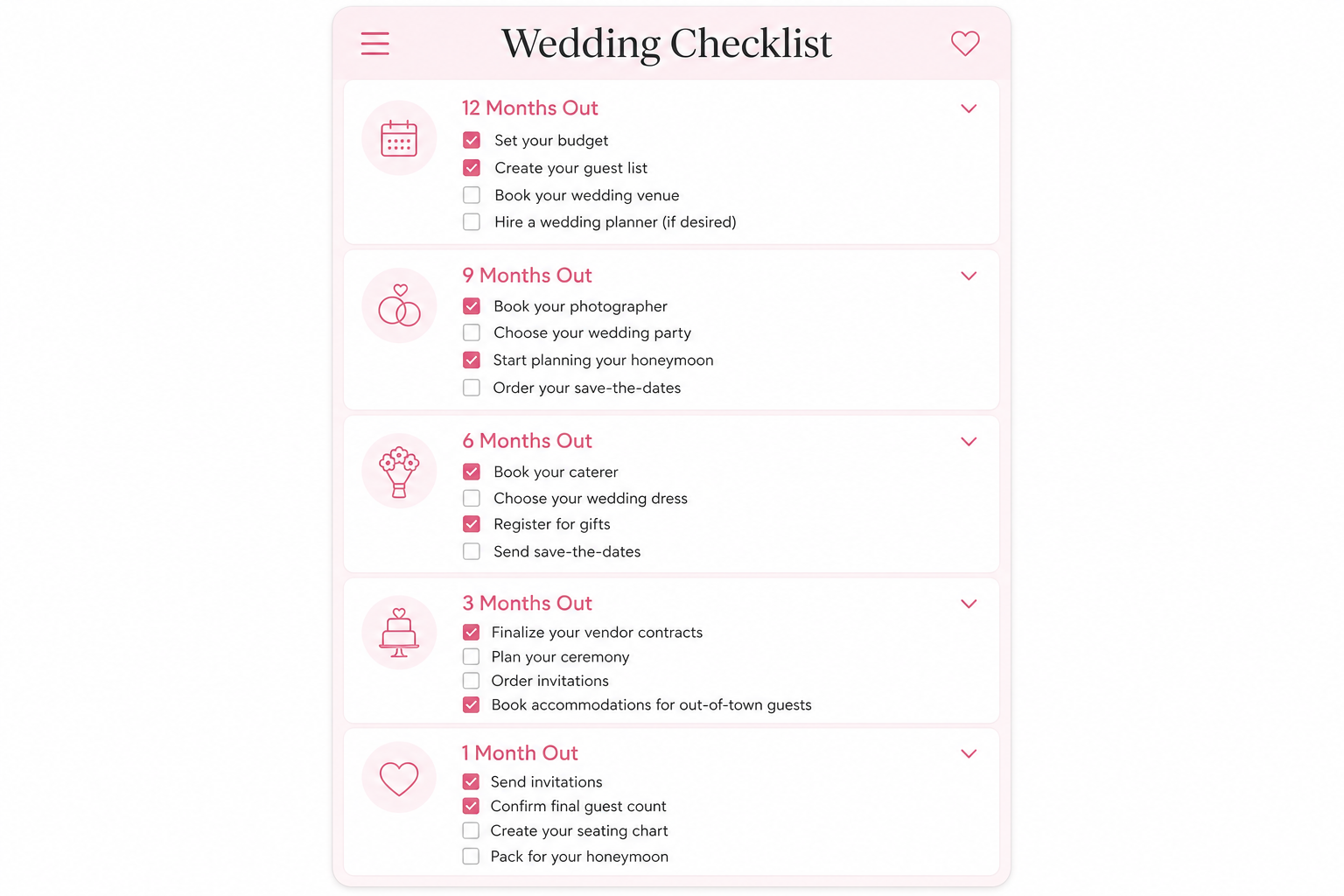
What If You Have Less Than 12 Months
A 6 to 9 month wedding is achievable but requires accepting constraints. Some vendors will not be available for your date. Venue choices narrow. The planning phases that normally happen in sequence have to happen simultaneously. If you are starting with less time, prioritise in this order: venue first, photographer second, caterer third, everything else after. Do not spend time on florals, stationery, or décor until those three are confirmed. The decisions you delay in the first month will cost you options in every month after it.
What If You Have More Than 18 Months
A longer engagement is not a problem. Most vendors are happy to hold a date further out and the early booking advantage is real. You have access to the full vendor market before peak booking season reduces your options. The main risk with a longer engagement is decision fatigue. Lock in the venue, photographer, and caterer early. Leave the smaller decisions, florals, stationery, and favours, until 9 to 12 months out. Making those decisions too early means revisiting them as your vision evolves, which creates unnecessary rework.
Where to Start Today
The first three decisions are the same regardless of your timeline: agree a rough budget range, agree a guest count range, and start venue research. Nothing else is actionable until those three are resolved. The guest count determines what venues are the right size. The budget determines what venues are realistic. The venue determines the date. Everything else follows from there.
The Planned Wedding gives you a 53-task checklist organised from 12 months out, alongside budget tracking, guest list management, vendor tracking, and a seating chart, all in one place. However long your planning window is, the checklist adapts to it. Start free — no credit card required. Open the app.