Wedding Planning Guides
Wedding Planning Checklist: 53 Tasks From 12 Months Out
The instinct when wedding planning begins is to search for a list. The problem is that a flat list with no timeline attached is not a planning system. It is a source of anxiety. Everything feels urgent simultaneously, nothing has a clear order, and the decisions that need to happen first are buried alongside ones that are months away. A checklist only works when it is organised by when each task actually needs to happen.
Why the sequence matters more than the list
Wedding planning is a sequential process, not a simultaneous one. Each major decision unlocks the next, and the order is not arbitrary. The venue and the date set the frame for everything else. The guest count determines what catering minimums apply, how many invitations are needed, and how much transport and accommodation has to be arranged. The catering choice influences the floor plan, which influences the seating chart, which depends on RSVPs that cannot be collected until invitations go out — and invitations cannot go out until the venue and date are confirmed.
If you treat the checklist as a flat list and start picking tasks based on what feels manageable, you will end up making decisions in the wrong order. The most common version of this is choosing vendors or sending save-the-dates before the guest count is realistic, which forces expensive reversals later. The sequence is the system. The list is just the surface.
12 to 9 months out: the foundational decisions
The first three months of planning are the highest-stakes phase because the decisions made here constrain everything that follows. Venue, date, and guest count are the three anchors. Once these are set, the rest of the planning has a frame to operate within. Without them, every subsequent decision is a guess.
What belongs in this window: agreeing a working budget range, agreeing a working guest count range, drafting a shortlist of venues that fit both, visiting venues, confirming the date, and signing the venue contract. If relevant, this is also when a full wedding planner is engaged. Planners who work with peak-season dates are booked out well in advance, and bringing one on after the venue is signed means they have no input on the single most expensive decision of the wedding.
Delays in this phase compress every phase after it. A venue confirmed at month seven instead of month ten does not give back the three months. It deletes them. Vendors who would have been available at month ten are no longer available at month seven, and you inherit a smaller set of options at higher prices for the rest of the planning window.
The Planned Wedding includes a 53-task wedding planning checklist organised by month from 12 months out. Tasks update automatically based on the wedding date entered during onboarding. Start free — no credit card required.
Start your free trial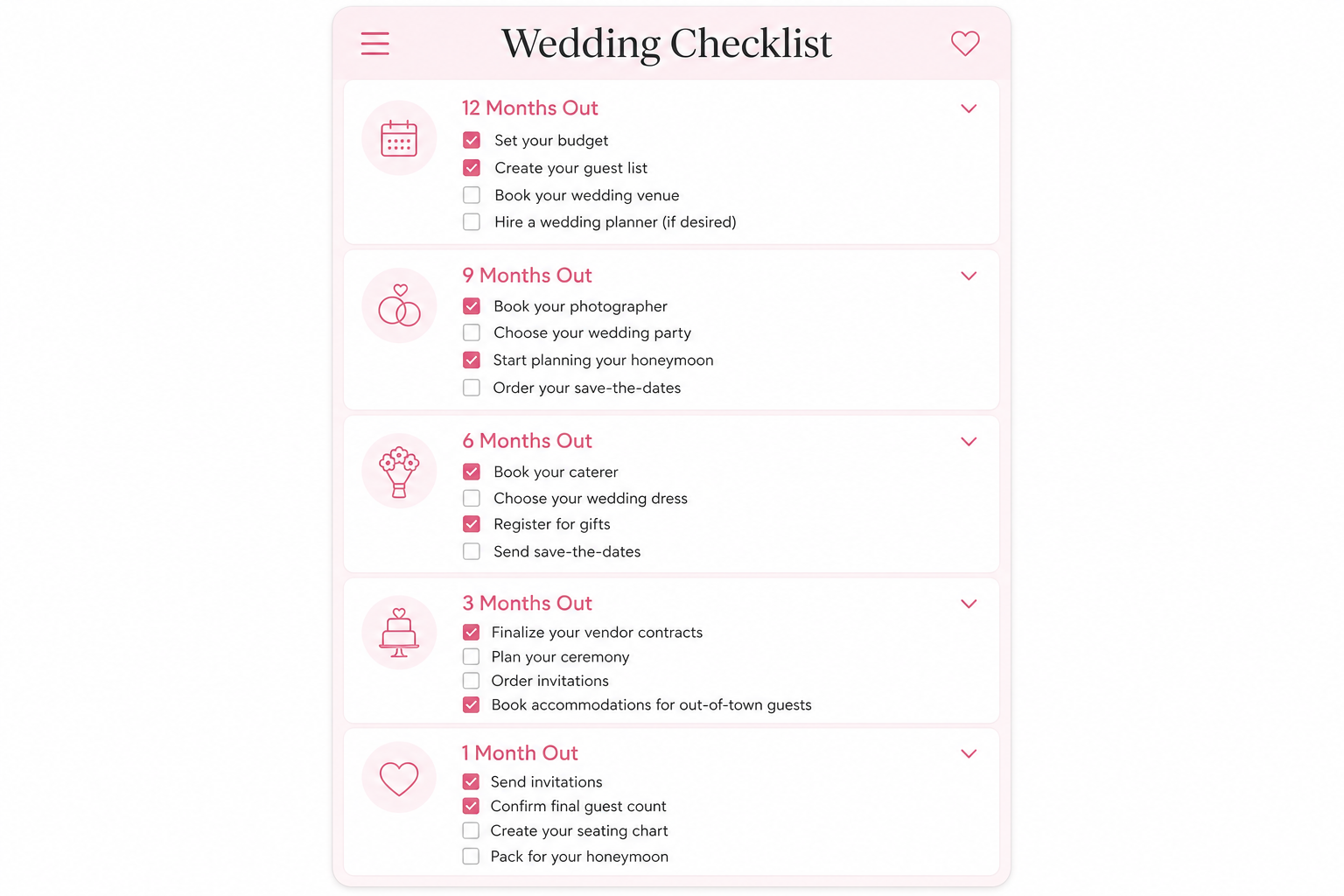
9 to 6 months out: the vendor booking window
The middle phase is when most vendors get booked for peak-season dates. Photographers, caterers, bands and DJs, florists, videographers, and hair and makeup artists all have a finite number of Saturdays in their calendar, and they fill those Saturdays in roughly this window. If you arrive here without a confirmed venue and a realistic guest count, you find your preferred vendors are no longer available, or are quoting prices that do not match the budget they had in mind.
What to prioritise in this phase: photographer and videographer first, because the strongest in any given market book the furthest out; caterer next, because catering quotes drive a large portion of the remaining budget; music, band or DJ, alongside the caterer; then florals and stationery. Officiant, transport, and accommodation blocks for out-of-town guests also belong in this window.
What can safely wait: hair and makeup trials, dress fittings, and the finer details of décor. These have shorter lead times and the available options do not shrink as quickly as core vendors.
6 to 3 months out: logistics and details
By this phase the major decisions are largely made, and planning shifts from selecting vendors to coordinating them. Invitations are designed, printed, and sent. RSVPs start coming in, and the working guest count begins to firm up into an actual guest count. The seating chart becomes possible for the first time. Vendor meetings move from initial consultation to final confirmation. Menus are tasted and locked, music playlists and do-not-play lists are agreed, floor plans are signed off.
This is the phase where organisation determines whether the final stretch is calm or chaotic. If you are tracking RSVPs, vendor confirmations, and outstanding payments in one place, you spend the last three months making small adjustments. If you are tracking the same information across email threads, spreadsheets, and notes apps, you spend the last three months firefighting things that should have been resolved here.
The final 3 months: confirmation and handoff
Almost everything that goes wrong in the final three months is a consequence of something that was not confirmed earlier. The work in this phase is less about new decisions and more about locking in what has already been agreed and communicating it clearly to everyone involved.
What needs to be locked in: final guest count to the caterer, final seating chart, ceremony details with the officiant, music selections with the band or DJ, shot list with the photographer, delivery and arrival times with every vendor, and the day-of timeline distributed at least two weeks before the wedding. Final dress and suit fittings also fall in this window.
The final two weeks are about handoff. You should not be the point of contact for vendor questions on the day itself. This is when you delegate operational responsibility to a day-of coordinator, a wedding planner, or a trusted member of the wedding party, so that the day runs from someone else's phone. Managing logistics from your own phone on the morning of the wedding is not finished planning; it is just postponing the planning into the day you were meant to be present for.
What to do right now
If you have just got engaged, the first three tasks are: set a rough budget range, agree on a guest count range, and start venue research. Nothing else needs to happen today. Every other decision waits on these three.
The Planned Wedding gives you 53 pre-loaded tasks organised from 12 months out, with budget tracking, guest list, vendor management, and a seating chart built in alongside the checklist. One place for everything. Start free — no credit card required. Open the app.